
Young-onset Alzheimer’s diagnosis after job loss sparks call for greater workplace awareness
Andrew Reid, a successful businessman began experiencing cognitive and visual changes. Misunderstood at work and eventually let go, he was later diagnosed with young-onset Alzheimer’s and posterior cortical atrophy. On March 12, he’ll urge leaders to see dementia as a workplace issue at the Breakfast to Remember in Vancouver.
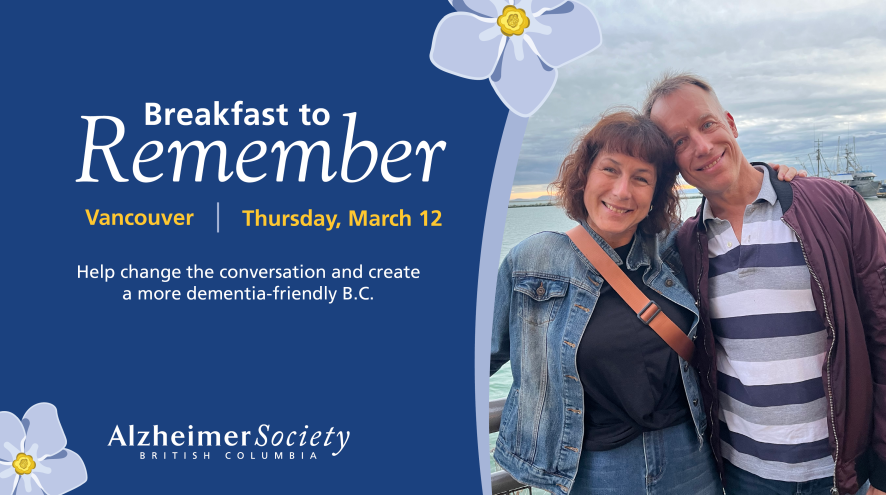
An entrepreneur, leadership consultant and former health-care executive, Andrew Reid built his career around helping organizations perform better, thriving in high-responsibility environments.
And then at the age of 55, things began to change.
Despite multiple visits to optometrists that showed nothing out of the ordinary, Andrew’s eyesight was no longer working the way it should. He experienced fatigue and things that once came easily were suddenly challenging. He started staying at work late each day to up.
“Nobody at work could make any of sense of it – my manager certainly didn’t,” says Andrew. “It was absolutely horrible.”
Andrew was let go from his job, cutting him off from the income and professional identity he’d spent years building. Initially misdiagnosed with epilepsy, it would be another year before a visit to the UBC Clinic for Alzheimer’s Disease and Related Dementia confirmed he was living with young-onset Alzheimer’s disease and a rare form of dementia called posterior cortical atrophy (PCA), often referred to as the visual variant of Alzheimer’s disease.
“It was a win,” says Andrew. “I could start to understand what has been happening to me and same with my family.”
For many families, Alzheimer’s disease and other forms of dementia are still viewed as a personal health issue. But Andrew and his wife Karina believe their experience highlights something business leaders often overlook: dementia is also a workplace issue, one that demands greater awareness, flexibility and compassion.
Andrew and Karina choose to not let dementia define them. They remain active in advocacy and public speaking. Andrew participates in research. With their two children, they’ve adapted – continuing to camp in new ways, replacing dragon boating with improv and starting mornings with walks.
Andrew’s optimism and Karina’s commitment to living in the present help to shape their journey. “There’s beauty in living for today,” says Karina. “You have to laugh daily.”
That optimism will be shared on March 12, when Andrew and Karina speak at the Alzheimer Society of B.C.’s fundraiser, Breakfast to Remember, presented by founding sponsor Murrick Group, in Vancouver.
Andrew and Karina hope to encourage leaders and employers to pause and be more curious about what might be going on beneath the surface. “It’s easy to dismiss symptoms,” says Andrew. “There are always reasons for sudden change and if we don’t ask, we’re not going to learn.”
Longtime supporter of the Breakfast, Robert Ezer, CEO of Amica Senior Lifestyles, says the event is an opportunity to reflect their shared commitment to improve the lives of seniors and advancing greater understanding of dementia. “Amica team members are encouraged to own their impact in ways meaningful to them,” says Mr. Ezer. “This event fundraises for important programs and services that make a tangible difference in the lives of people affected by dementia.”
Cathryn France, Chief Development Officer of the Alzheimer Society of B.C., hopes Andrew and Karina’s story serves as a reminder that as more people leave the workforce earlier than expected, dementia is not only a personal issue it is increasingly a workplace and community issue. “The Breakfast to Remember offers business leaders insight into how organizations can better support employees through flexible policies, increased awareness and compassionate leadership,” says Cathryn.
As Karina puts it, “By supporting the Alzheimer Society of B.C., you’re supporting people and helping build a future where this disease is better understood, better supported and one day, eradicated.”
Breakfast to Remember will be held in Vancouver on March 12 at the Vancouver Fairmont Waterfront Hotel, with additional events in Kelowna on February 26 and Victoria on March 12. To donate or purchase tickets, visit BreakfastToRemember.ca.